

Upadacitinib Alopecia Areata Hair Regrowth: Phase 3 Trial Facts
Table of Contents
Introduction: An Arthritis Pill Makes Headlines in Dermatology
What the UP-AA Trials Actually Measured
Myth 1: "This drug restores 100% of hair."
Myth 2: "It's approved for arthritis, so it's safe for any hair loss."
Introduction: An Arthritis Pill Makes Headlines in Dermatology
Few headlines travel faster than one promising a full head of hair. When international media reported that a once-daily arthritis drug had restored 100% of scalp hair in some patients with severe alopecia areata, the story spread well beyond dermatology circles. The drug in question is upadacitinib, an oral Janus kinase (JAK) inhibitor already prescribed for rheumatoid arthritis, atopic dermatitis, and several inflammatory bowel conditions.
The news is grounded in serious science. In August 2026, JAMA Dermatology published the results of two parallel, replicate Phase 3 randomized clinical trials — UP-AA1 and UP-AA2 — led by Dr. Arash Mostaghimi of Brigham and Women's Hospital and Harvard Medical School. Together they enrolled 1,399 adults and adolescents aged 12 to 64 across more than 230 sites in 28 countries, including North America, Europe, and China.
The results are genuinely meaningful for a disease that has long had few reliable options. But "100% hair restoration" describes a minority of trial participants, not a typical outcome — and the distance between a headline and a clinical decision is precisely where patients need careful, evidence-based guidance.
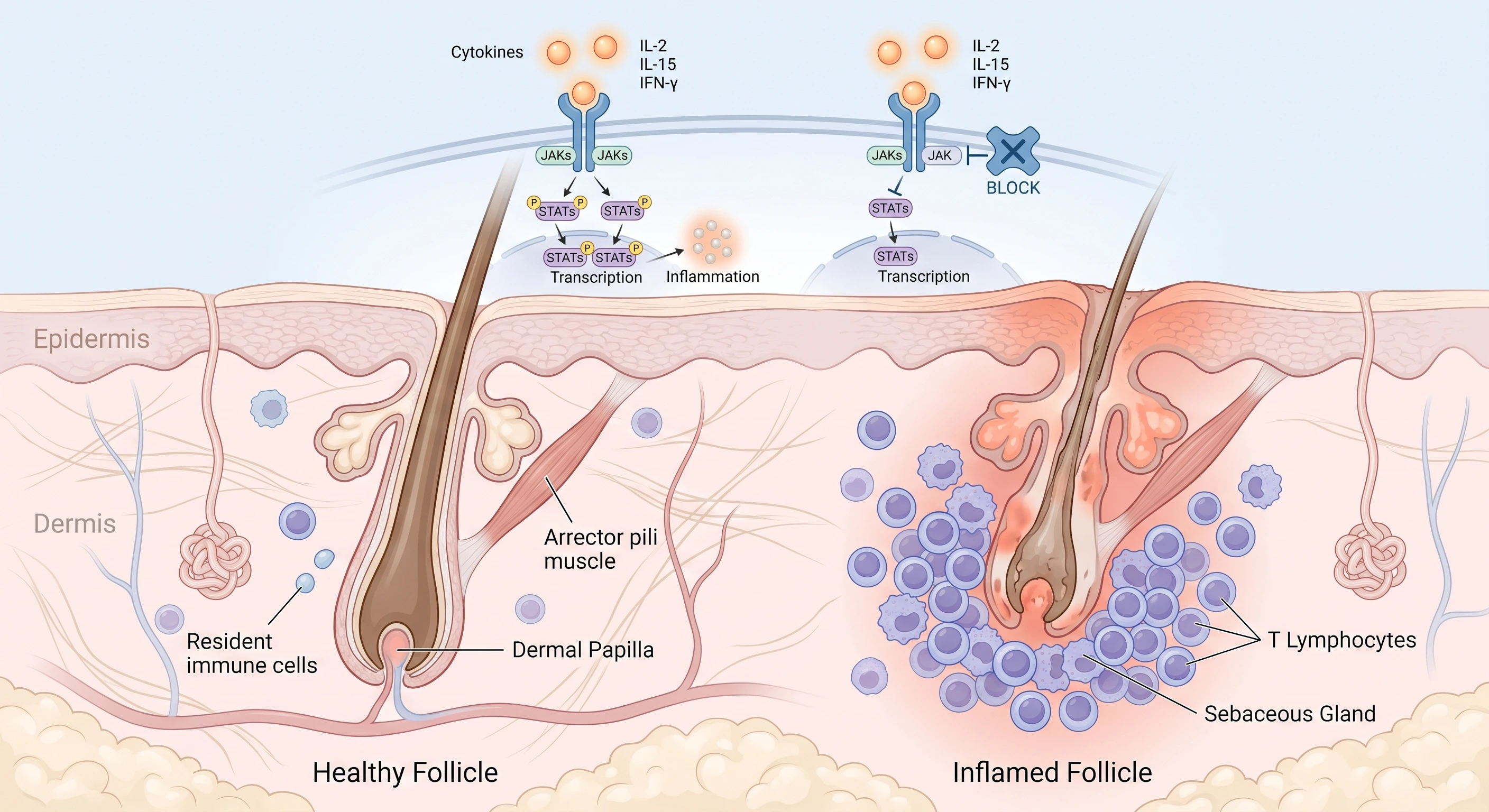
Alopecia areata is not ordinary thinning. It is an autoimmune disease in which the immune system attacks the hair follicle, producing non-scarring hair loss that ranges from small patches to complete loss of scalp, facial, and body hair. Its global prevalence is estimated at around 2%, and its psychological burden is substantial. Crucially, because the follicle is not destroyed, it retains the capacity to regrow hair once the immune attack is controlled — which is exactly the biological premise behind JAK inhibition.
What the UP-AA Trials Actually Measured
Population: Severe alopecia areata (SALT score ≥ 50); mean baseline SALT of about 84, with roughly half of participants showing near-total or total scalp loss. 118 adolescents were included.
Treatment: Upadacitinib 15 mg or 30 mg once daily, or placebo, for 24 weeks, followed by a blinded extension to 52 weeks.
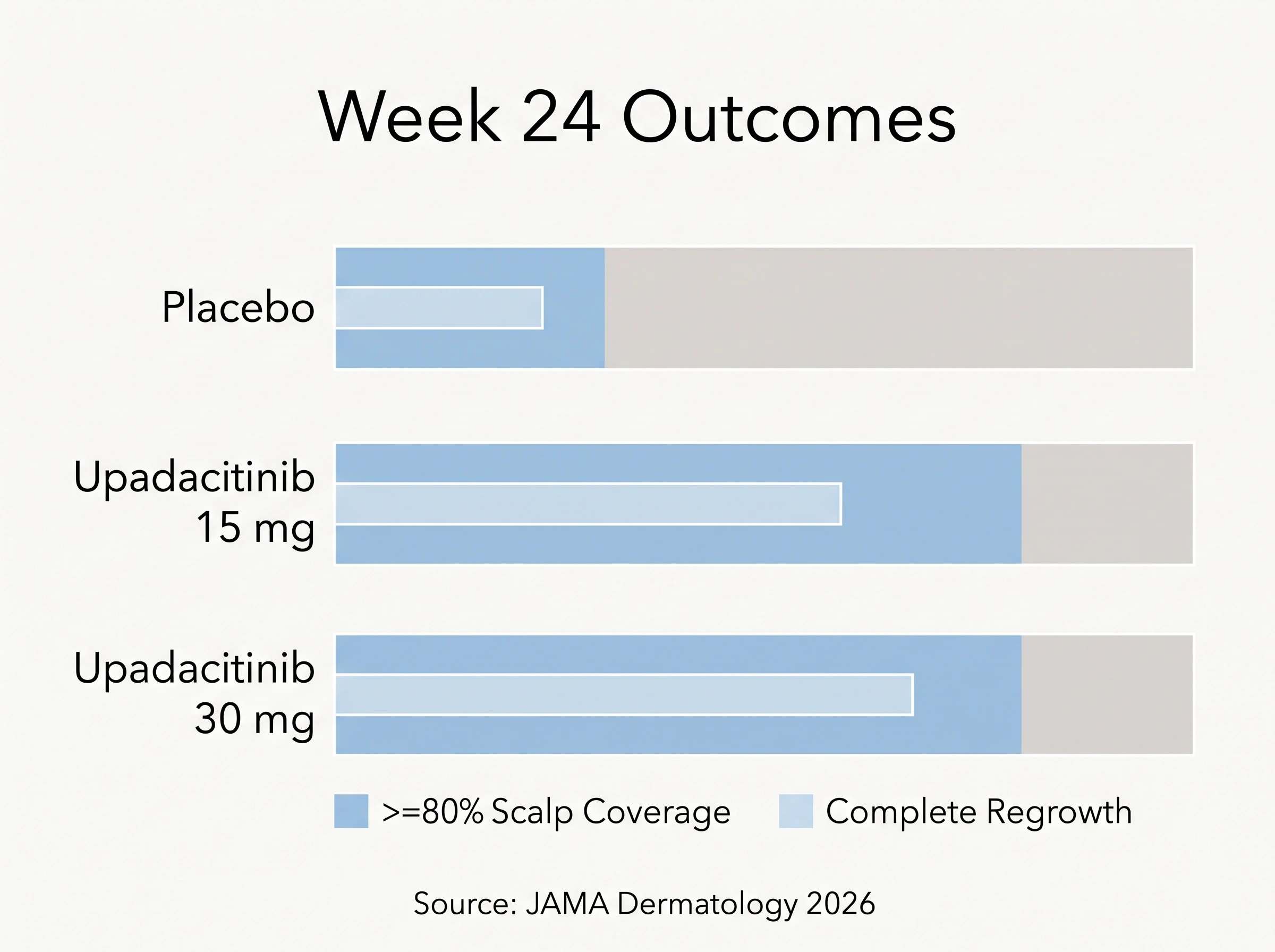
Primary end point: SALT ≤ 20 (at least 80% scalp coverage) at week 24.
At week 24, about 45% (15 mg) and 55% (30 mg) of patients reached the primary end point, versus 1.5–3.4% on placebo. Complete regrowth (SALT = 0) occurred in roughly 13–14% (15 mg) and 20–23% (30 mg), versus 0% on placebo. Serious adverse events were 1.6%, 2.3%, and 0.4%, respectively. Responses kept rising through week 52.
Myths vs. Clinical Reality
Myth 1: "This drug restores 100% of hair."
Clinical reality: Complete regrowth was achieved by about 1 in 5 patients on 30 mg and 1 in 7 on 15 mg. The representative figure is that about half reached 80% coverage — meaning 45–55% did not reach the primary end point by week 24. Real-world results may differ.
Specialist note: As specialists in this field, we observe that the "100%" framing compresses a nuanced distribution of outcomes into its most favorable tail.
Myth 2: "It's approved for arthritis, so it's safe for any hair loss."
Clinical reality: The trials studied severe alopecia areata only, not pattern, stress-related, nutritional, or scarring hair loss. Common adverse events included upper respiratory infection, acne, and elevated creatine phosphokinase; shingles was also reported. JAK inhibitors carry class safety warnings for serious infections, malignancy, cardiovascular events, and thrombosis. Regulatory status varies by country.
Specialist note: As specialists in this field, we are unequivocal: no one should obtain or take an arthritis medication on their own to treat hair loss. Its safety profile depends on close medical supervision.
Myth 3: "Once hair grows back, the alopecia is cured."
Clinical reality: JAK inhibitors suppress the immune activity driving the disease; they do not eliminate the autoimmune predisposition. With other JAK inhibitors, hair loss frequently recurs when treatment stops. Current UP-AA data cover 52 weeks, and a third long-term study is underway. The trials were manufacturer-funded and not head-to-head with other approved JAK inhibitors.
Specialist note: As specialists in this field, we observe that the accurate framing is disease control, not cure.
When to Consult a Specialist
Hair loss has many causes, and an accurate diagnosis is the essential first step before any treatment discussion. Consider seeking evaluation from a board-certified dermatologist — ideally one with experience in hair and scalp disorders — if you notice:
Sudden, well-defined round or oval bald patches on the scalp, beard area, eyebrows, or elsewhere.
Rapidly progressing hair loss, or loss extending to eyebrows, eyelashes, or body hair.
Nail changes such as pitting or ridging accompanying hair loss, which can be associated with alopecia areata.
Hair loss in a child or adolescent, which warrants prompt pediatric dermatology assessment.
A personal or family history of autoimmune conditions (such as thyroid disease or vitiligo) alongside new hair loss.
Significant emotional distress, anxiety, or social withdrawal related to hair loss — in which case support from a psychologist or psychiatrist can be a valuable part of care.
Before a JAK inhibitor, a specialist will confirm the diagnosis, review cardiovascular, thrombotic, cancer, and infection risks, and order baseline screening. Patients already on a JAK inhibitor should consult their prescribing physician.
Conclusion
The UP-AA program is among the most rigorous evaluations of an oral therapy for severe alopecia areata, and a response in roughly half of patients is clinically significant. Still, upadacitinib restrains an immune attack rather than permanently repairing follicles, and its benefits are inseparable from medical screening and monitoring. Durability beyond one year remains an open question. The right treatment for any individual depends on proper diagnosis and an informed conversation with a qualified specialist.
This content reflects the professional opinion of Dr. Aleksandr Orlov of the PrecisionBio team, provided when consulted on this topic, and is published with Carlos López, CEO of PrecisionBio. It is for educational purposes only and is not medical advice. Upadacitinib must be used only under qualified medical supervision. Always consult your primary care physician or a board-certified specialist about your health.