
Okinawa Longevity Diet Myth: What the Science Really Says
Table of Contents
Introduction: A Tuber, an Island, and a Global Narrative
Myth 1: The purple sweet potato is the secret
Myth 2: One diet can add decades to your life
Myth 3: Okinawans are still the longest-lived people on Earth
Myth 4: The centenarian numbers are beyond question
Myth 5: Eating less is a proven human longevity strategy
What the Evidence Actually Supports
Introduction: A Tuber, an Island, and a Global Narrative
Few stories in popular nutrition have travelled as far as the one about Okinawa. For decades, this subtropical Japanese prefecture was described as home to one of the highest concentrations of centenarians ever recorded, and a single food, the sweet potato (imo), became the symbol of that achievement. Today, the vivid purple beni-imo appears on wellness menus, supplement labels and social media feeds as if it were a validated anti-aging intervention.
A recent long-form review of the evidence, published by Space Daily in August 2026, revisits the historical record and reaches a far more cautious conclusion: the sweet potato was a caloric staple of one specific generation of Okinawans, but the data cannot isolate it as the cause of their longevity. Several of the most repeated claims also rest on shaky methodological ground.
This is precisely where the Okinawa longevity diet myth deserves careful scrutiny. The purpose of this article is not to dismiss Okinawa’s remarkable history, but to separate what the observational data genuinely show from what popular narratives have added along the way.

Myths vs. Clinical Reality
Myth 1: The purple sweet potato is the secret
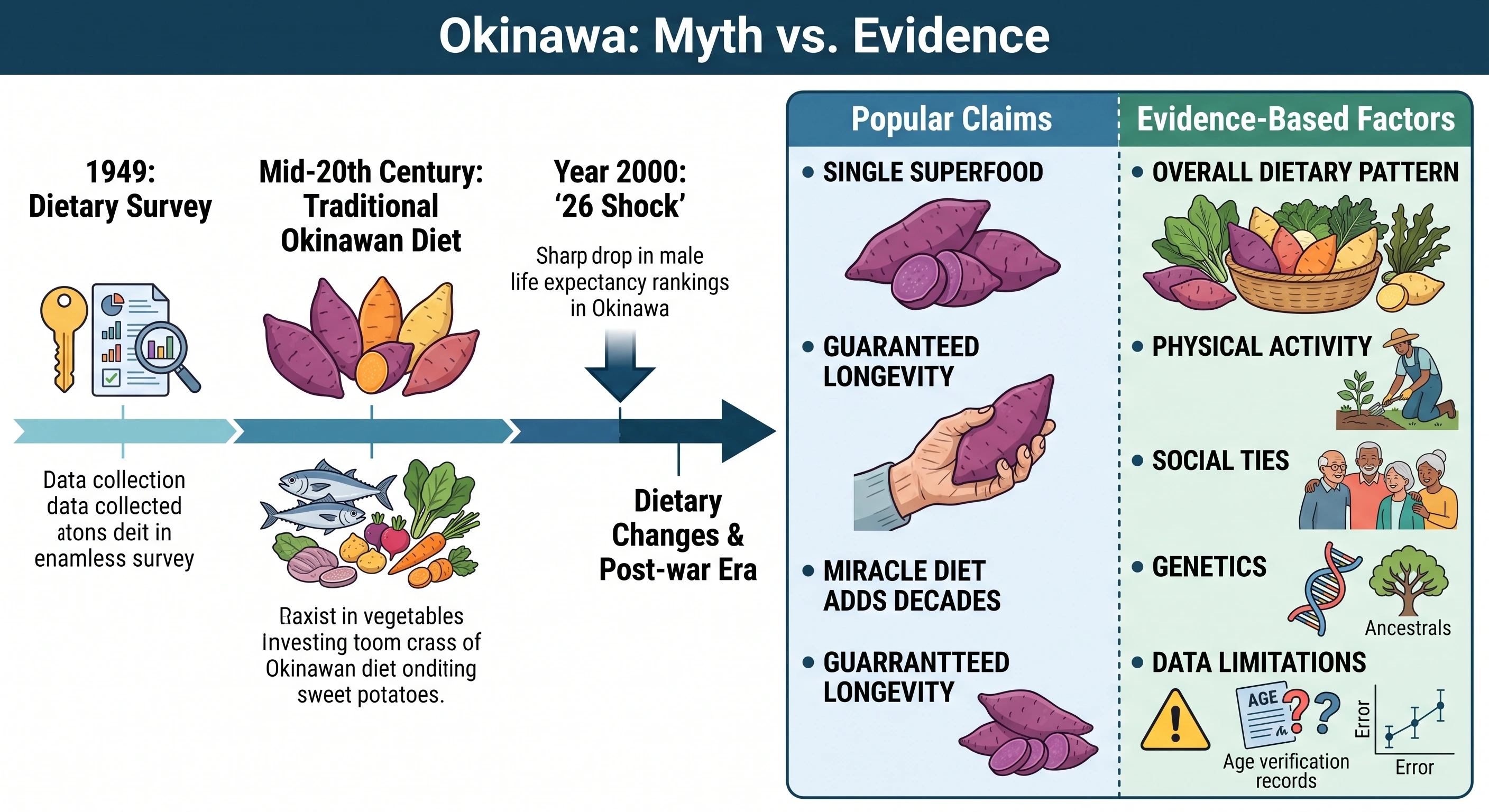
The staple was not exclusively purple. Reconstructions based on a 1949 food survey describe mixed varieties, many orange or yellow.
Lab findings are not human outcomes. Anthocyanin-rich extracts show antioxidant activity experimentally, but no controlled human study shows the tuber extends lifespan.
Context matters. The diet was low in calories, sugar and animal fat, rich in greens, seaweed and soy, and paired with daily physical labor and close social ties.
As specialists in the field, we observe that attributing a population outcome to a single food is a common interpretive error.
Myth 2: One diet can add decades to your life
The evidence is observational, so it cannot establish causation.
Survivorship bias hides those who ate the same foods and died at 70.
A 2026 scoping review of more than five decades of centenarian research found no single food, gene or habit explains extreme longevity; lifestyle factors contribute modestly, alongside heritability and chance.
Myth 3: Okinawans are still the longest-lived people on Earth
In 2000, male life expectancy fell to 26th among Japan's 47 prefectures, the "26 shock."
After 1945, processed meats, flour, sugar and fried foods replaced sweet potatoes, and obesity rose faster than in the rest of Japan.
National survey reporting now places Okinawa near the bottom for vegetable intake and at the top for body mass index.
The "Okinawa effect" belonged to a cohort and an era, not a place or an ingredient.
Myth 4: The centenarian numbers are beyond question
Extreme-age records worldwide may reflect clerical errors or pension misreporting; Japan's 2010 audit found many registered centenarians who could not be located or had died.
Much of Okinawa's documentation was destroyed in 1945. Critics link centenarian clusters to record gaps; Okinawa Centenarian Study researchers dispute this, and the debate remains open.
Myth 5: Eating less is a proven human longevity strategy
Caloric restriction extends lifespan in many laboratory animals, but human studies show only changes in metabolic and cardiovascular markers, not longer life.
Restriction carries risks for older adults (muscle loss, frailty) and people with chronic conditions or a history of disordered eating.
What the Evidence Actually Supports
A generation born roughly 1890–1920 appears to have reached 100 at above-average rates, though figures are debated, and the advantage faded within four decades as lifestyles changed. What survives scrutiny: fiber-rich, minimally processed eating, daily activity and social connection are associated with better health. These are patterns, not miracle ingredients.
When Should You Consult a Specialist?
Before a high-carbohydrate or calorie-restricted diet, especially with diabetes or kidney disease: an endocrinologist, primary care physician or registered dietitian.
Older adults with weight loss, weakness or fatigue: a board-certified geriatrician or internist.
If you take glucose-lowering, anticoagulant or blood pressure drugs: your prescribing physician or a clinical pharmacist.
Before "longevity" supplements or a restrictive diet with a history of disordered eating: your physician or a licensed mental health professional.
Conclusion
The Okinawan centenarians were real people who lived through extraordinary circumstances, and their history remains a valuable object of study. Yet the popular version of their story, in which a purple tuber unlocks a longer life, is built on a chain of simplifications: a mixed crop recast as a single variety, observational correlations read as causation, survivors studied without the non-survivors, and demographic records treated as more reliable than they may be.
The more rigorous lesson is also the less marketable one. Longevity emerges from the interaction of genetics, cumulative lifestyle patterns, social environment, healthcare and chance over many decades. The fading of Okinawa’s advantage after its diet and way of life changed is a reminder that population health is dynamic, not a fixed property of a place or a food. Scientific literacy, rather than the search for a single secret, remains the most reliable foundation for informed health decisions.
This content reflects the professional opinion of Dr. Aleksandr Orlov of the Precision Bioclinic team, affiliated with PrecisionBio Clinic (CEO: Carlos López), when consulted on Okinawan longevity and the traditional Okinawan diet. It is for educational purposes only and is not medical advice. No food should be considered a longevity treatment. Before changing your diet, supplements or medications, consult your primary care physician or a board-certified specialist.