

Meditation Cerebrospinal Fluid Study: What Vanderbilt Found
Table of Contents
Myth #1: "This study proves meditation clears Alzheimer's proteins from the brain."
Myth #2: "Meditation can replace sleep for brain maintenance."
Myth #3: "Any level of meditation experience would show this same effect."
When Should You Talk to a Specialist About Brain Health and Meditation?
Introduction
Headlines move faster than data. In August 2026, a peer-reviewed Vanderbilt University study, published in the Proceedings of the National Academy of Sciences, began circulating online with a seductive claim: that focused meditation might mimic what the sleeping brain does to clear away proteins associated with Alzheimer's disease. Some secondary coverage compressed a careful physiology paper into a headline suggesting meditation could protect against dementia. The actual study is narrower — and arguably more interesting — than that.
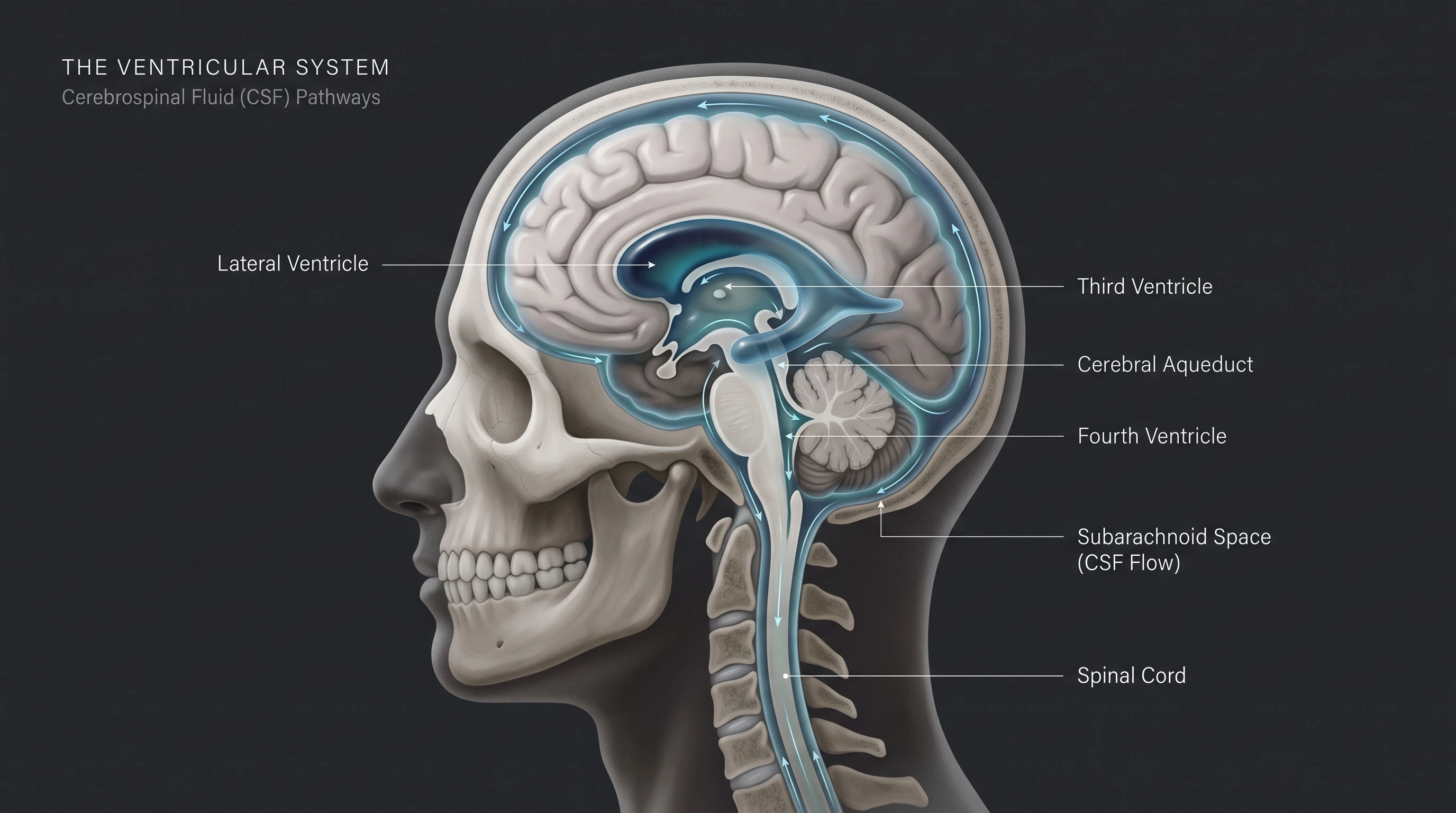
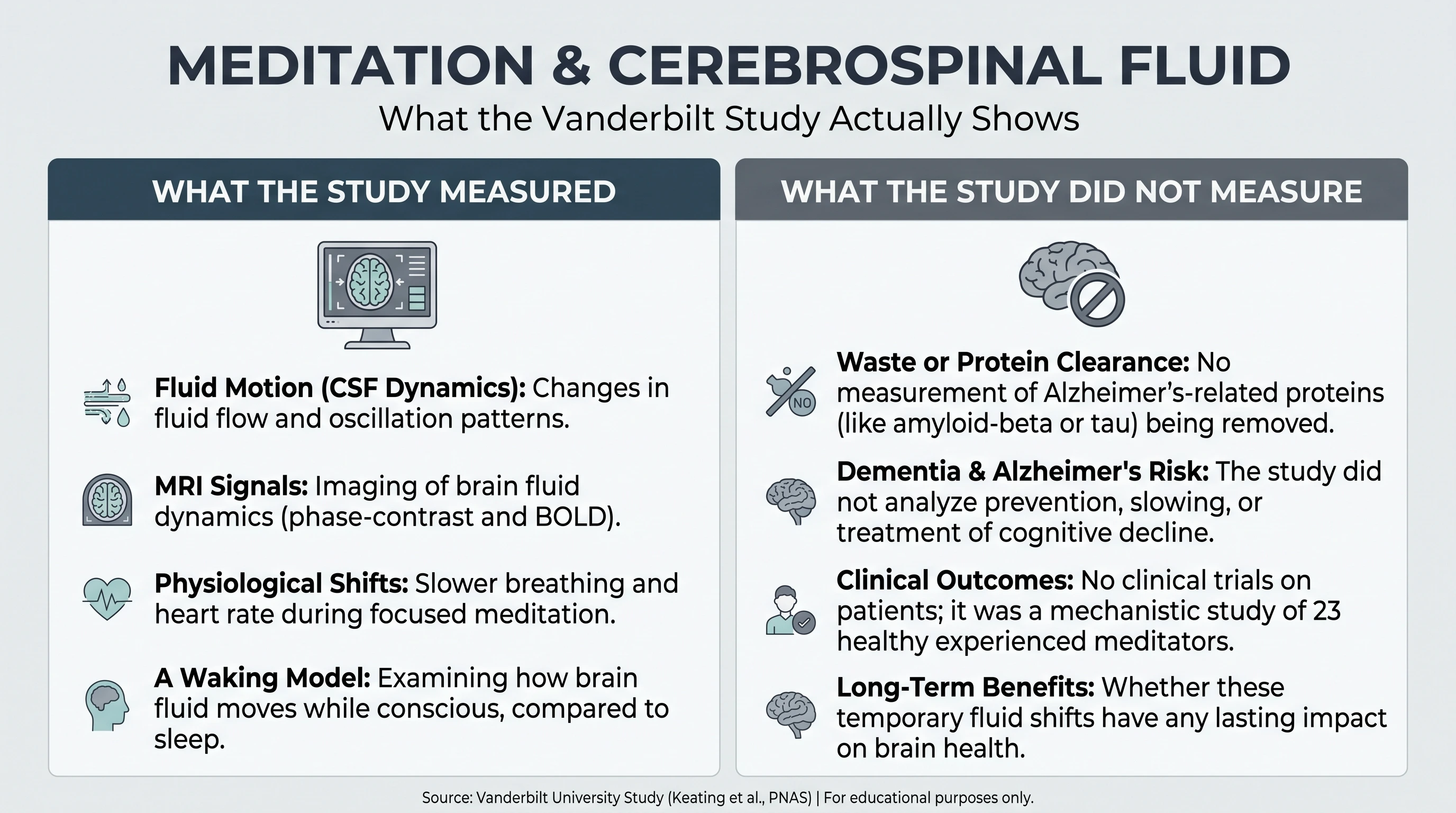
Researchers led by Bryce Keating, David Vago, and Manus Donahue used two MRI-based techniques — phase-contrast imaging of the cerebral aqueduct and blood-oxygenation-level-dependent imaging near the skull base — to track cerebrospinal fluid (CSF) dynamics in 23 experienced meditators. During focused-attention meditation, breathing and heart rate slowed, backward ("regurgitant") CSF flow decreased, and low-frequency CSF oscillations near the skull base grew stronger, resembling signals previously linked to non-REM sleep, the state in which the brain's fluid-exchange systems are thought to be most active.
That is the entire finding: a measurable shift in fluid movement through specific brain compartments during a waking, attention-focused state. The study did not track amyloid-beta, tau, or any other waste protein, and it did not measure clearance. It does not show that meditation prevents, slows, or treats Alzheimer's disease.
Myths vs. Clinical Reality
Myth #1: "This study proves meditation clears Alzheimer's proteins from the brain."
Clinical Reality: The Vanderbilt team measured CSF motion — how much fluid moved, in which direction, and at what frequency — using MRI. They did not use a tracer or biomarker to measure whether amyloid-beta, tau, or any other metabolic byproduct was actually removed from brain tissue. As specialists in the field, we would note that fluid dynamics and solute clearance are related but distinct physiological questions, and the current literature on this distinction is genuinely unsettled: a 2024 mouse study in Nature Neuroscience found that fluorescent-tracer clearance was actually reduced during sleep and anesthesia, while a 2025 human study using an implanted sensor found signals consistent with increased glymphatic exchange overnight. The field has not converged on a single answer, which makes any claim of "brain detox" premature.
Myth #2: "Meditation can replace sleep for brain maintenance."
Clinical Reality: The researchers describe focused-attention meditation as producing a distinctive fluid-dynamics signature — not as functionally equivalent to sleep. Sleep involves coordinated slow-wave neural activity, vascular changes, and CSF oscillations operating together over extended periods, alongside processes (such as hormonal regulation and memory consolidation) that a short meditation session does not replicate. The study's authors themselves frame their result as "a waking model" useful for research purposes, explicitly not a substitute for restorative sleep.
Myth #3: "Any level of meditation experience would show this same effect."
Clinical Reality: The core finding came from 23 experienced meditators, not beginners. Two additional groups — one practicing slowed breathing, one repeating a passive scanning condition — served as controls and did not reproduce the aqueduct-flow change, which strengthens confidence that the effect is not simply due to slower breathing or a second-scan artifact. However, the sample size remains small, the meditators completed the two conditions in a fixed rather than randomized order, and it is unknown whether novice meditators, different meditation styles, or shorter practice durations would show a comparable pattern.
Myth #4: "This means people at risk for Alzheimer's should meditate instead of seeking medical care."
Clinical Reality: Nothing in this study addresses dementia risk, diagnosis, or treatment. It is a mechanistic physiology study in healthy adult meditators, not a clinical trial in patients with cognitive symptoms or Alzheimer's disease. Extrapolating from altered fluid oscillations to disease prevention skips several unproven steps, including whether the fluid pattern has any lasting effect, whether it translates into measurable clearance, and whether clearance (if it occurs) meaningfully changes long-term brain health outcomes.
When Should You Talk to a Specialist About Brain Health and Meditation?
Curiosity about a headline like this often reflects a broader, legitimate concern: memory changes, sleep problems, or a family history of dementia. That concern deserves a proper clinical conversation rather than a lifestyle shortcut drawn from an early-stage physiology study. Consider seeking a professional evaluation if you notice:
Progressive memory lapses that are new or worsening, especially if noticed by family members or colleagues
Increasing difficulty with familiar tasks, language, or orientation in time and place
Chronic sleep disruption, since sleep quality itself is independently linked to long-term brain health
A strong family history of early-onset dementia or Alzheimer's disease
Any new neurological symptom — confusion, disorientation, sudden cognitive change — that appears abruptly
In these situations, a neurologist or a board-certified geriatrician is the appropriate point of contact for evaluation, not a wellness practice adopted in response to a single study. Meditation can be a reasonable, evidence-supported tool for stress reduction and general well-being, but it should be framed as exactly that — a wellness practice — rather than a medical intervention for a diagnosable brain condition.
Conclusion
The Vanderbilt study is a genuinely useful piece of physiology research: it is among the first to show, using two independent MRI methods, that a specific mental state — sustained, focused attention — can shift measurable cerebrospinal fluid dynamics while a person remains fully awake. That is scientifically interesting on its own terms. It opens a research avenue for understanding how attention, arousal, breathing, and vascular tone interact with brain fluid movement, independent of sleep.
This article reflects the professional opinion of Dr. Aleksandr Orlov of the Precision Bioclinic team, provided upon request for commentary on the topic discussed above, with contributions from Carlos López (CEO), PrecisionBio Clinic. It is intended for general educational purposes only and does not constitute medical advice, diagnosis, or treatment for any individual condition.