

Lacosamide Osteoarthritis Cartilage Repair: What Yale Found
Table of Contents
Introduction: An Old Drug, a New Question
Understanding the Science: Nav1.7 and the Cartilage Cell
Myth 1: "An FDA-approved drug can now reverse osteoarthritis."
Myth 2: "Since the drug exists, patients can ask for it now."
Myth 3: "If it works in animals, it will work in people."
Myth 4: "This could replace knee replacement."
Introduction: An Old Drug, a New Question
Osteoarthritis is a leading cause of chronic pain and disability, yet its treatment remains largely symptomatic: analgesics, anti-inflammatories, corticosteroid injections, physical therapy and, eventually, joint replacement. Medicine still lacks a disease-modifying therapy that changes the course of cartilage loss.
A recent Yale University study in Bioactive Materials, led by Chuan-Ju Liu, PhD, investigated lacosamide, an FDA-approved antiseizure medication, as a candidate for osteoarthritis cartilage repair. The drug reduced pain-related signaling and shifted cartilage cells from degradation toward repair, most strongly when delivered into the joint through an engineered hydrogel. These findings are preclinical, derived from laboratory and animal models rather than human trials.
Understanding the Science: Nav1.7 and the Cartilage Cell
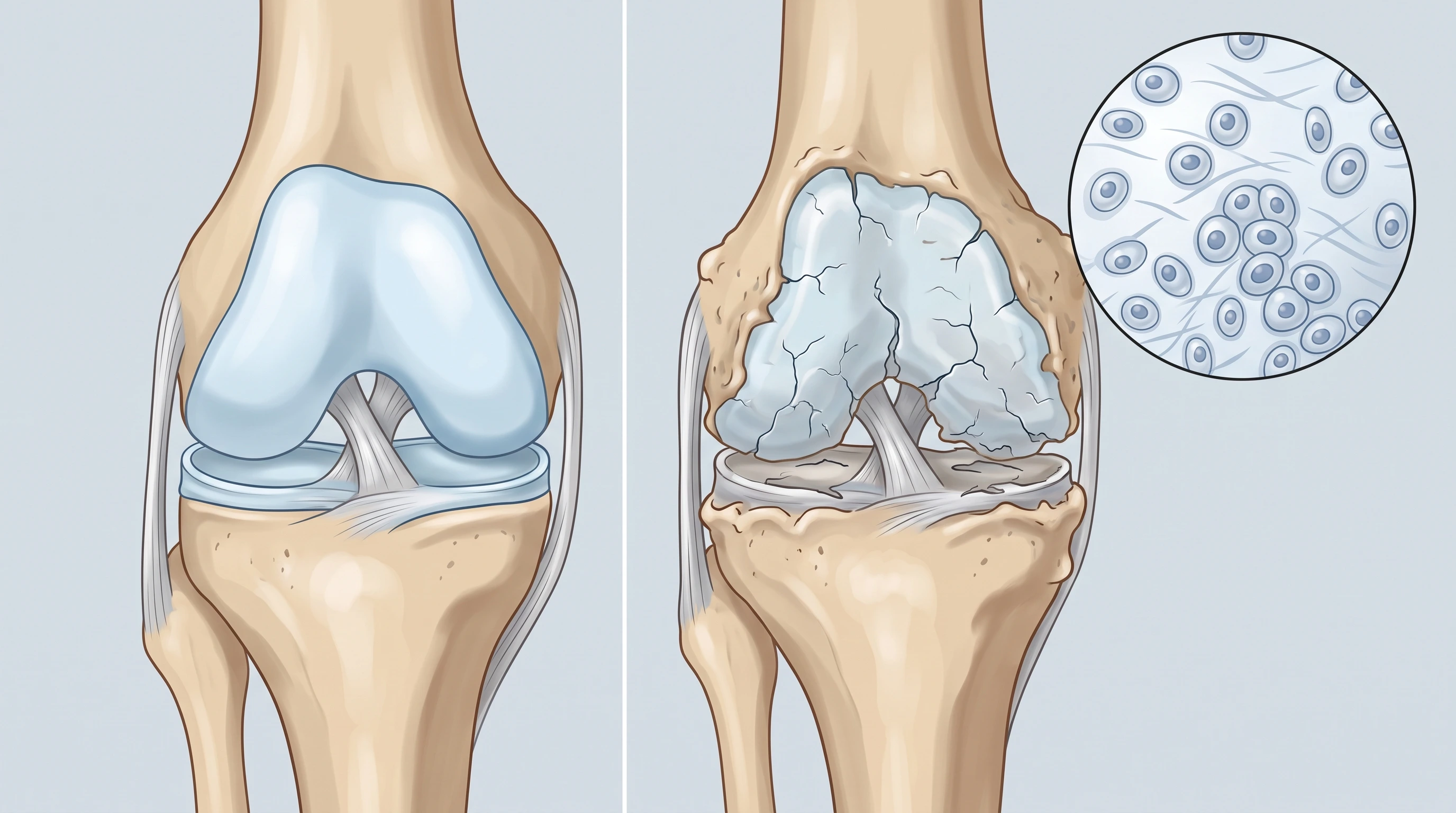
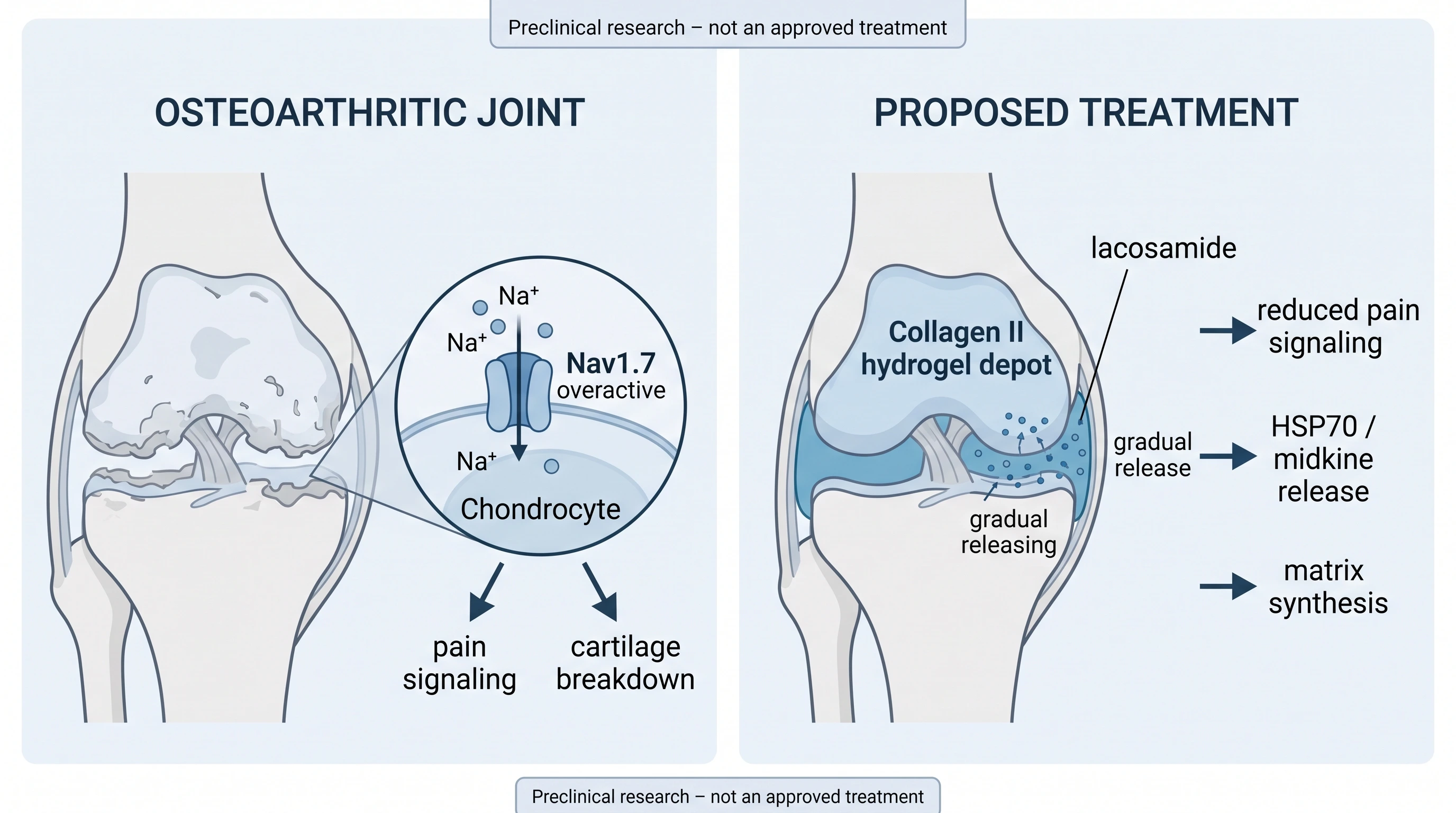
Cartilage is maintained by chondrocytes, which balance matrix synthesis with tissue removal; in osteoarthritis, degradation outpaces repair. The Yale team reported that Nav1.7, a sodium channel known for its role in pain-transmitting neurons, is also expressed in chondrocytes and becomes overactive in osteoarthritis, amplifying pain while pushing these cells toward breaking down tissue. Screening existing sodium channel inhibitors, they found lacosamide effective at low concentrations. Key observations:
Narrow therapeutic window: benefits appeared only within a specific low-dose range.
Protective signaling: increased release of HSP70 and midkine, proteins linked to repair and reduced inflammation.
Local delivery: a thermoresponsive Collagen II hydrogel releasing the drug over several weeks; one injection every four weeks outperformed daily oral dosing in the models.
Myths vs. Clinical Reality
Myth 1: "An FDA-approved drug can now reverse osteoarthritis."
Reality: Lacosamide is approved for seizure disorders. No clinical trial has shown it repairs human cartilage; "reversal" in a model means changes in tissue markers, not a restored human knee.
Myth 2: "Since the drug exists, patients can ask for it now."
Reality: The tested intra-articular hydrogel is experimental and not commercially available. Approved lacosamide is a systemic medication with side effects such as dizziness and cardiac conduction changes, and it is a controlled substance in the United States. The narrow effective dose range argues strongly against off-label use. As specialists in the field, we observe that "already FDA-approved" is often misread as "already available for this purpose"; repurposing does not replace dedicated trials.
Myth 3: "If it works in animals, it will work in people."
Reality: Animal models develop damage over weeks, while human osteoarthritis evolves over years, shaped by age, weight, alignment and prior injury. Several promising preclinical candidates have failed to translate clinically.
Myth 4: "This could replace knee replacement."
Reality: A disease-modifying therapy would matter most in earlier stages. In advanced, bone-on-bone disease, no drug has been shown to rebuild a joint surface, and joint replacement remains an effective option for selected patients.
What is genuinely promising: a single target influencing both pain and cartilage, a potential non-opioid strategy, biomaterial-based delivery, and a possibly shorter path to trials, though the new formulation requires its own safety evaluation. We view this as a well-constructed proof of concept requiring replication, human safety studies and randomized controlled trials.
When Should You Consult a Specialist About Joint Pain?
Seek evaluation for joint pain lasting more than a few weeks, stiffness after rest, swelling or instability, reduced range of motion, or pain that disrupts sleep. Seek prompt care if a joint becomes suddenly hot, red and swollen, especially with fever, or after significant injury.
Helpful specialists include a board-certified rheumatologist, orthopedic surgeon, sports medicine physician or physiatrist, usually coordinated by your primary care physician. Never start or adjust medications such as lacosamide to treat joint pain; ask your physician about registered clinical trials instead.
Conclusion: A Promising Signal, Not Yet a Treatment
The Yale study unites a new target, a repurposed drug with a known safety record, and a biomaterial that keeps it in the joint, pointing toward osteoarthritis as a modifiable disease. Yet the evidence remains preclinical and the formulation experimental. The responsible reading is measured optimism, while timely evaluation, weight management, exercise, physical therapy and evidence-based care remain the foundations of joint health.
This content reflects the professional opinion of Dr. Aleksandr Orlov of the Precision Bioclinic team, provided when consulted on the research discussed, with institutional context from Carlos López, CEO of PrecisionBio Clinic. It is educational only and not medical advice. The findings are preclinical; lacosamide is not approved for osteoarthritis, and the hydrogel formulation is experimental. Do not modify any medication based on this content. Always consult your primary care physician or a board-certified specialist.
Reference: He C, Huang G, Moradi L, et al. Collagen II hydrogel-mediated sustained delivery of lacosamide attenuates cartilage degeneration and pain in osteoarthritis. Bioactive Materials, 2026. DOI: [10.1016/j.bioactmat.2026.02.045](https://doi.org/10.1016/j.bioactmat.2026.02.045)