iPSC Stem Cell Therapy for Heart Failure: Myths vs. Clinical Reality
Table of Contents
Introduction: A Headline Worth Reading Twice
Understanding the Science: What Are iPSC-Derived Heart Cells?
Myth 1: "Stem cells reversed heart failure in 90% of patients."
Myth 2: "Scientists can now regrow dead heart muscle."
Myth 3: "It is a simple, low-risk injection."
Myth 4: "This treatment will soon be available."
Myth 5: "All cardiac stem cell therapies are the same."
What the Trial Design Can and Cannot Tell Us
Introduction: A Headline Worth Reading Twice
In August 2026, international media reported that a stem cell therapy developed in China had “reversed heart failure in 90% of patients.” The news referred to a clinical study led by cardiothoracic surgeon Dr. Dongjin Wang at Nanjing Drum Tower Hospital, affiliated with Nanjing University, whose results were published in Nature Medicine under the name HEAL-CHF.
The study is genuinely important. It is one of the first randomized, controlled human trials to test iPSC stem cell therapy for heart failure, an approach that the field of regenerative cardiology has pursued for more than a decade. For patients living with advanced heart failure, and for the families who support them, it is understandable that a figure like “90%” generates hope.
However, the peer-reviewed publication tells a more nuanced story than the headline. The trial treated 10 patients, compared them with 10 control patients, and its primary goal was to evaluate safety, not to prove that the therapy works. Several of the most important measures of heart function did not differ between groups after one year.
This article examines what the study actually found, where public expectations have outpaced the evidence, and what patients with heart failure should realistically take away from this development.
Understanding the Science: What Are iPSC-Derived Heart Cells?
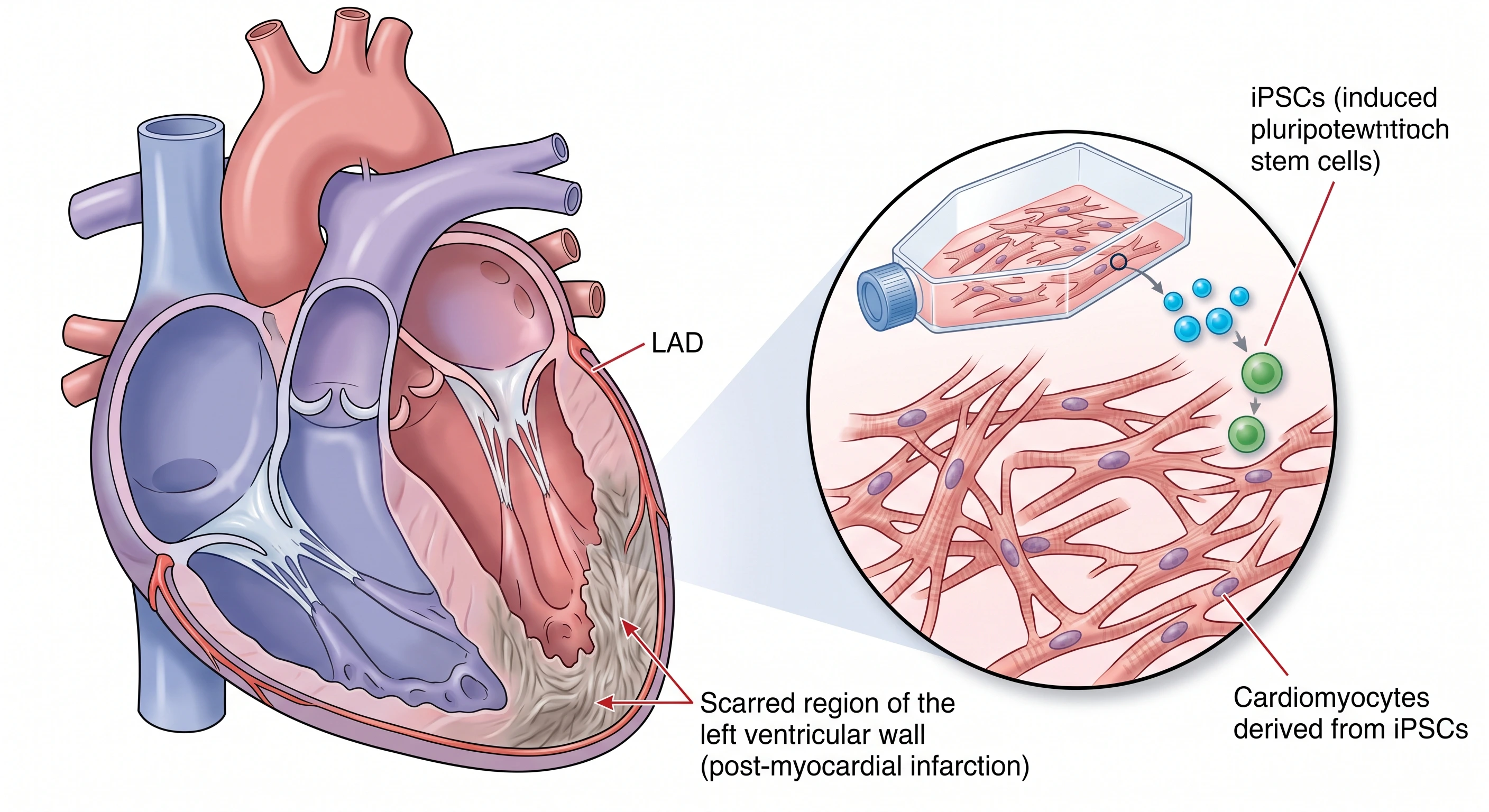
After a heart attack, dead heart muscle is replaced by scar tissue, and adult cardiomyocytes barely regenerate. Medications, devices, and coronary artery bypass grafting (CABG) restore blood flow and slow progression, but none replace lost muscle.
Induced pluripotent stem cells (iPSCs) are adult cells reprogrammed into an embryonic-like state that can become beating heart muscle cells (iPSC-CMs), without the ethical constraints of embryonic cells. In HEAL-CHF, the cells were allogeneic (from a donor line) and injected into the damaged heart wall during open-chest bypass surgery.
Myths vs. Clinical Reality
Myth 1: "Stem cells reversed heart failure in 90% of patients."
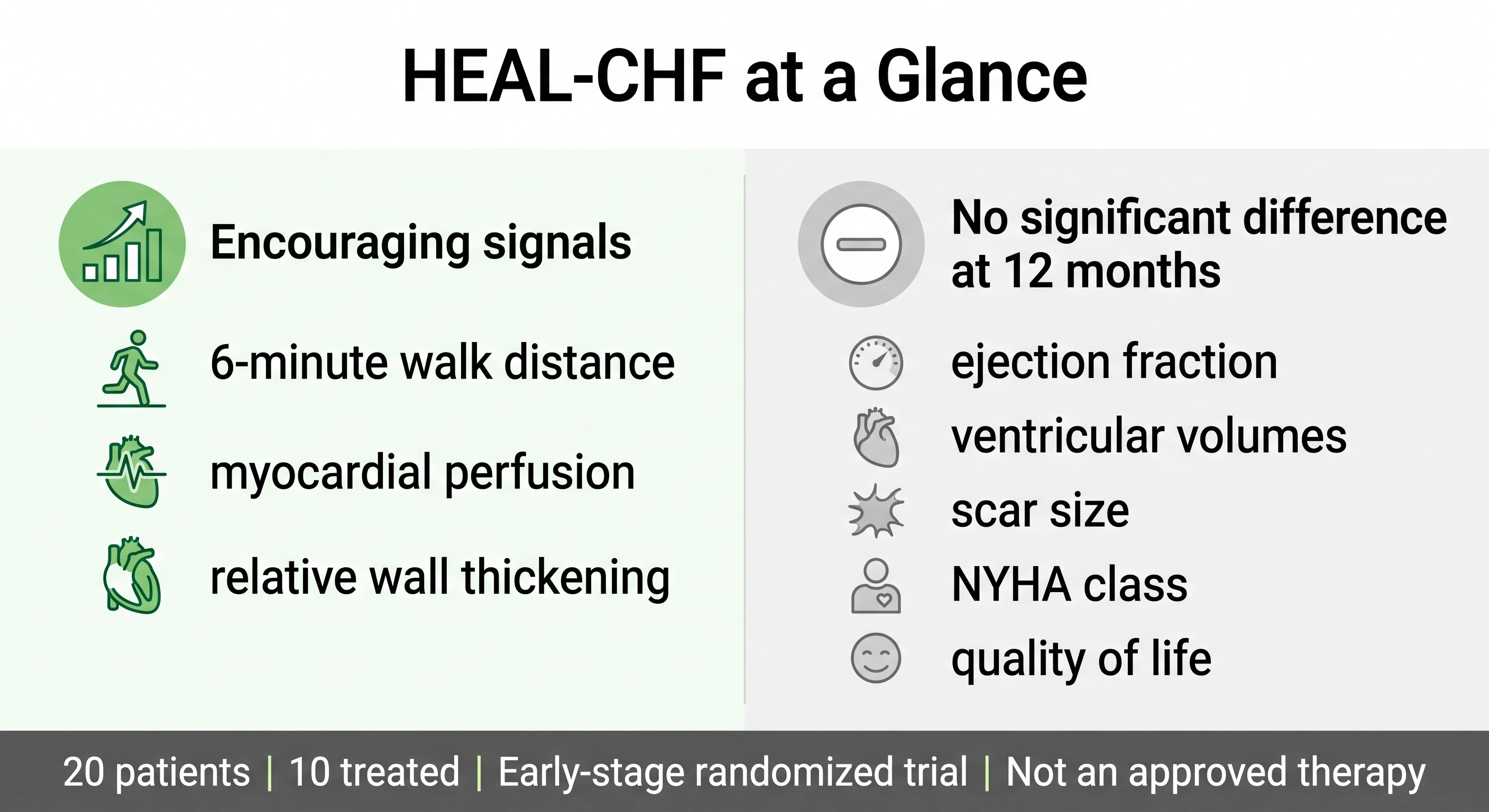
Clinical Reality: The "90%" figure comes from hospital communications and press coverage, not the peer-reviewed abstract. Secondary analyses favored the cell group in 6-minute walk distance, myocardial perfusion, and wall thickening, but at 12 months there were no significant differences in LVEF, ventricular volumes, scar size, NYHA class, or quality of life. As specialists, we observe that LVEF and functional class are among the parameters cardiologists rely on most; "reversal" does not describe these findings.
Myth 2: "Scientists can now regrow dead heart muscle."
Clinical Reality: Scar size did not shrink significantly, and it remains unresolved whether any benefit comes from true engraftment or from indirect paracrine effects, a distinction with very different long-term implications.
Myth 3: "It is a simple, low-risk injection."
Clinical Reality: Cells were delivered during major open-heart surgery. All 10 treated patients developed accelerated idioventricular rhythm, and two had significant ventricular tachycardia resolved by cardioversion. No sustained ventricular tachycardia or tumor formation was detected at one year. The authors themselves call for studies establishing the risk-to-benefit ratio.
Myth 4: "This treatment will soon be available."
Clinical Reality: The therapy is not FDA-approved or a standard of care. A Phase 3 pivotal trial of roughly 80 bypass patients has been registered; approval typically takes several years.
Myth 5: "All cardiac stem cell therapies are the same."
Clinical Reality: iPSC-CMs differ fundamentally from bone marrow, adipose, or mesenchymal cells, so evidence cannot be transferred between products.
What the Trial Design Can and Cannot Tell Us
As specialists, we note a very small sample (20 participants), a single center, an open-label design without placebo, limited diversity (18 of 20 were men), bypass surgery in both arms, industry funding with disclosed author ties, and only one-year follow-up. The result is a promising safety and feasibility signal, not a proven cure.
When Should You Consult a Heart Specialist?
News about regenerative cardiology can prompt patients to seek new options. The most important step, however, remains an accurate diagnosis and optimized, evidence-based care. Consider seeking evaluation from a board-certified cardiologist or a heart failure specialist if you experience:
Shortness of breath during routine activities, such as climbing stairs or walking short distances.
Difficulty breathing when lying flat, or waking up at night short of breath.
Swelling in the ankles, legs, or abdomen.
Rapid, unexplained weight gain over a few days, which can reflect fluid retention.
Persistent fatigue or reduced exercise tolerance.
Palpitations or a sensation of an irregular heartbeat.
Seek emergency care immediately in the event of chest pain, severe breathlessness, fainting, or signs of a heart attack.
If you already live with heart failure, ask whether your treatment is optimized to current guidelines and whether you qualify for a registered clinical trial (ClinicalTrials.gov). Be wary of paid, unapproved stem cell offers.
Conclusion
HEAL-CHF shows that allogeneic iPSC-derived heart cells can be delivered during surgery and followed for a year without tumors or sustained dangerous arrhythmias, with encouraging gains in exercise capacity and perfusion. Yet core heart function measures matched bypass alone, and the evidence rests on ten patients. Larger, independently replicated trials will determine whether iPSC stem cell therapy for heart failure becomes a clinical reality.
This content reflects the professional opinion of Dr. Aleksandr Orlov, regenerative medicine physician at PrecisionBio Clinic, when consulted on iPSC-derived cell therapy and the HEAL-CHF trial, published with the institutional backing of Carlos López, CEO of PrecisionBio Clinic. It is educational only and not medical advice.