
Biological Age & Personalized Medicine: What One Study Reveals
Table of Contents
Myth: "This study proves you can reverse your biological age by 15 years."
Myth: "Biological age is a single, objective number, like a blood pressure reading."
Myth: "Wearables plus fasting and exercise is now a proven anti-aging protocol."
Myth: "Faster metabolic switching automatically means better health."
Introduction
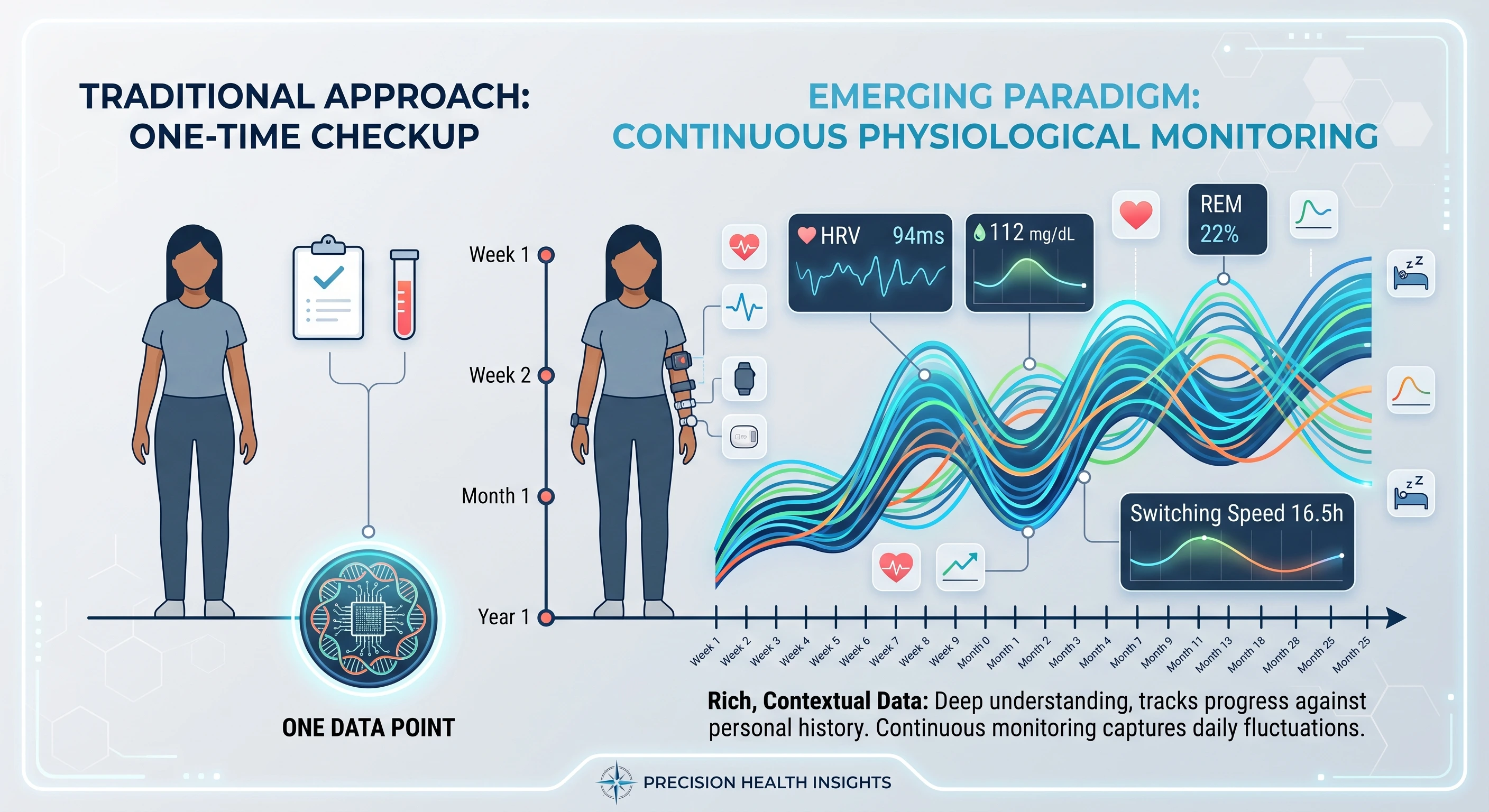
Most people learn about their health once a year, through a single blood panel and a brief consultation. That annual snapshot has long stood in for self-knowledge, yet it captures almost nothing about what happens between visits: how sleep debt builds, how metabolism shifts after a stressful week, or how the body recovers day to day.
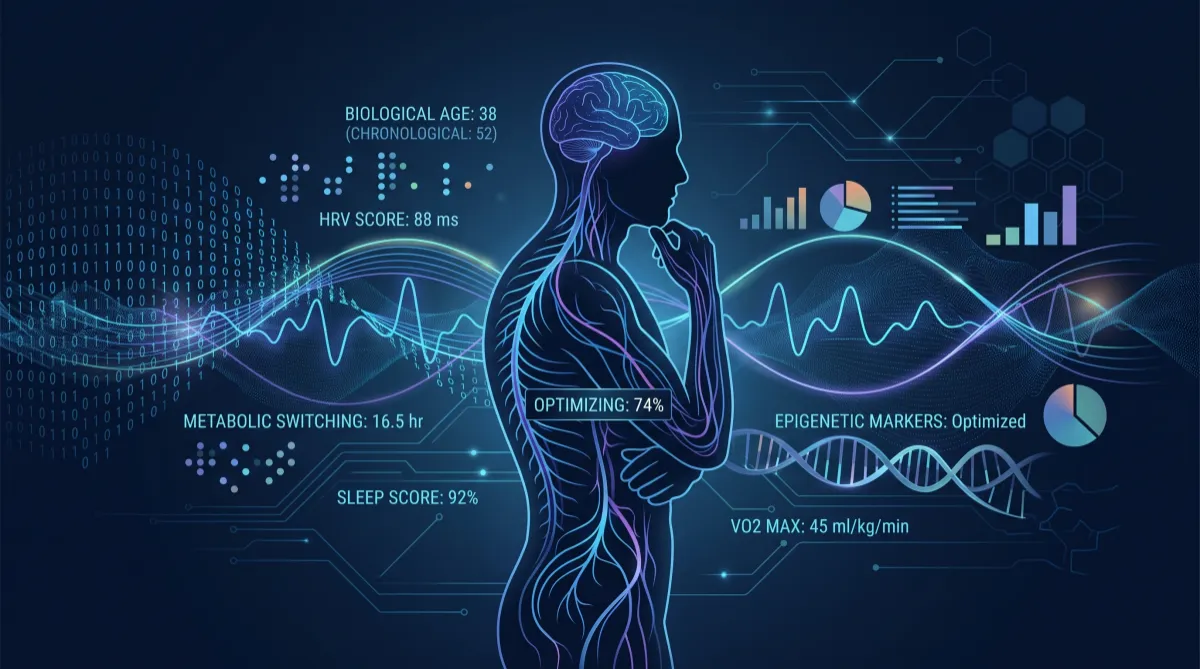
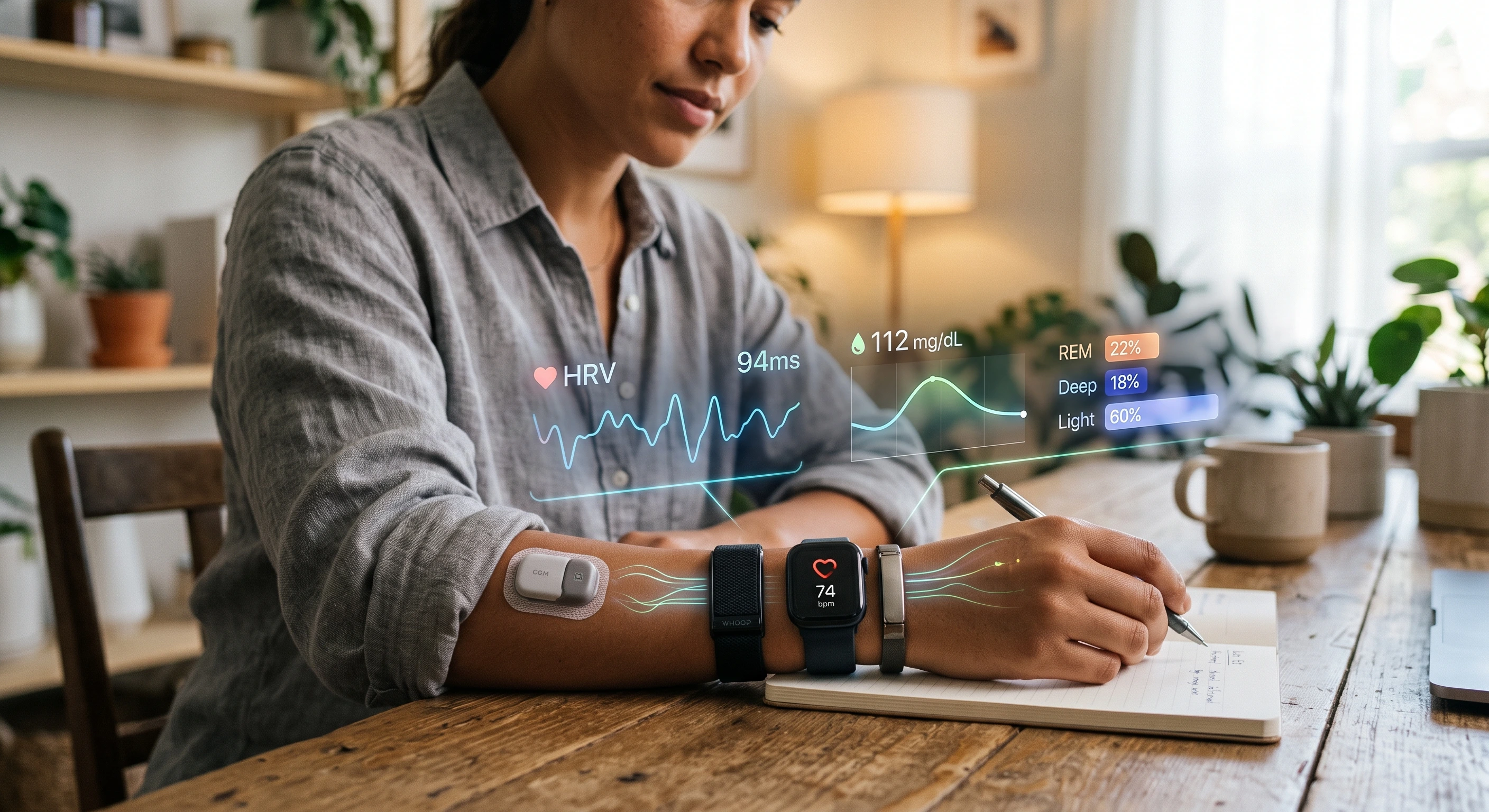
A recent study from the Yong Loo Lin School of Medicine at the National University of Singapore puts that gap in sharp focus. Professor Dean Ho, director of the Institute for Digital Medicine, became the sole subject of his own research project, DELTA. Over roughly eight months, Ho wore three consumer wearables simultaneously while an AI model tracked his response to a structured series of lifestyle interventions, including varying fasting windows, exercise routines, and nutrition patterns. Published in the peer-reviewed journal PLOS One, the project reported Ho's estimated biological age at around 32 — some 15 years below his chronological age of 47 — alongside a marked improvement in "metabolic switching speed," the time needed to shift from burning glucose to burning fat, which fell from over 24 hours to about 16.5 hours.
The headline number has traveled fast in the media. The more scientifically interesting story, however, is the underlying premise: that health is not a fixed trait measured once a year, but a dynamic, individual baseline that shifts with stress, sleep, diet, and illness.
Myths vs. Clinical Reality
Myth: "This study proves you can reverse your biological age by 15 years."
Clinical Reality: The 15-year figure describes one 47-year-old man's estimated biological age after eight months of an intensive, closely monitored personal regimen — not a population result, and not a reversal that has been demonstrated to generalize to other people. As specialists in the field, we would note that an n-of-1 design, however rigorously instrumented, answers a different question than a randomized clinical trial: it tells us what happened in one physiology under one set of conditions, not what will happen for people with different genetics, comorbidities, or starting points. The finding is best read as a proof of concept for a measurement approach, not as a validated protocol ready for clinical replication.
Myth: "Biological age is a single, objective number, like a blood pressure reading."
Clinical Reality: Biological age is a statistical estimate derived from an algorithm trained on physiological and molecular markers — it is a model's inference, not a direct measurement of cellular aging. Different algorithms, trained on different datasets, can and do produce different estimates for the same person. The DELTA study's AI copilot was built specifically around this one individual's longitudinal data, which is a strength for detecting change within that person over time, but a limitation when it comes to comparing his result against population-level aging clocks.
Myth: "Wearables plus fasting and exercise is now a proven anti-aging protocol."
Clinical Reality: The interventions described — variable fasting windows, including extended fasts, along with adjusted exercise and nutrition — were tailored and closely supervised within a research context, not a standardized regimen validated for public use. Extended fasting in particular carries real physiological demands and is not appropriate for everyone, including people with certain metabolic, cardiovascular, or eating-related conditions. As specialists, we observe that translating an intensively monitored self-experiment into everyday practice requires far more than adopting the same schedule; it requires the kind of individualized assessment and supervision that made the original study possible in the first place.
Myth: "Faster metabolic switching automatically means better health."
Clinical Reality: Metabolic switching speed — how quickly the body transitions between using glucose and fat as its primary fuel — is one physiological marker among many, and its improvement in this case is a meaningful signal worth further study, not a stand-alone verdict on overall health. Robust conclusions about metabolic flexibility and long-term health outcomes require larger, controlled studies that track diverse populations over time, ideally with standardized protocols that can be compared across sites and cohorts.
When Should You Consult a Specialist?
Studies like DELTA are valuable precisely because they point toward a future in which health monitoring is continuous and individualized rather than a once-a-year snapshot. But that future does not remove the need for professional medical guidance — if anything, it makes it more important, since interpreting continuous physiological data correctly requires clinical context that a consumer device or app cannot provide on its own.
It is reasonable to seek a professional evaluation when:
You are considering any structured fasting regimen, particularly extended fasts, and have an existing metabolic, cardiovascular, endocrine, or eating-related condition.
Wearable data shows persistent, unexplained changes in resting heart rate, heart rate variability, sleep architecture, or recovery metrics.
You want to understand what a "biological age" score from a consumer app or test actually measures, and how (or whether) it should inform your health decisions.
You are planning significant lifestyle changes — in diet, exercise intensity, or sleep patterns — and want them tailored to existing conditions or medications.
In these situations, the appropriate step is a consultation with a certified internal medicine physician, endocrinologist, or geriatrician, depending on your age and specific concerns, who can interpret personal health data within the context of your full medical history.
Conclusion
The real contribution of this self-experiment is conceptual rather than prescriptive. It shows that physiology can be tracked with a granularity that annual screenings cannot capture, and that meaningful change may be detectable over months. That is a genuinely interesting data point for personalized, longitudinal medicine, a field still translating continuous monitoring into clinically validated care. What the study does not do is establish a replicable anti-aging protocol — and treating a single case as a population-level finding would misread the science.
This article reflects the professional opinion of Dr. Aleksandr Orlov of the Precision Bioclinic team when asked to comment on the referenced study and topic. It is intended for general educational purposes only and does not constitute medical advice, diagnosis, or treatment recommendations. The findings discussed are derived from a single-subject (n-of-1) research study and should not be interpreted as validated or generalizable clinical protocols.